Inexplicably, Israelis LOVE cover bands. Some are ok, some are woefully terrible, and a surprisingly large amount are a knee-slappin, toe-tappin good time.
Introducing the LesBeat Beatles cover band, an oddly named but nonetheless very enjoyable band who knows how to get the crowd groovin.
In case you live in Tel Aviv and see this post in time, they are performing tonight at the Radio bar.
Enjoy!

7.12.10

6.12.10
Jamaica – Jerusalem
"Get up in the morning, slaving for bread, sir,
So that every mouth can be fed.
Poor me, the Israelite."
Why in the world would a Jamaican ska/reggae musician refer to the "Israelites" in his song? Because Demand Dekker was a Jamaican ska/reggae artist who was influenced by the popular Rastafarian spiritual movement spread out in his homeland which has a deep-rooted connection with Judaism. The roots of Rasta/Jewish mix begin all the way back to that steamy affair between King Solomon and the Queen of Sheba with a strange blend of Jewish flavor creeping into the spiritual history of Ethiopia, turning up subtly in 20th century Rastafarian lifestyle, and then inevitably in reggae music.
Yes. There are historical, iconographical and spiritual parallels that provide credence to the weird cocktail between Judaism and Rastafari. From a historical perspective it is told that Menelik, Solomon’s only son with Queen Sheba, stole the Ark of the Covenant from the temple in Jerusalem and carried it to Ethiopia where some suggest it still remains. Over 2000 years later, Rastafarians appear in Jamaica as adherents of Hailie Salsie who see him as the 2nd coming of Christ. To make a long story short, Rastas begin to refer to Jewish historical concepts in their liturgy, songs and prayer. Reference to Zion and Promise Land, Exodus are everywhere in the Rasta world.
The term most commonly noted with Rasta is "Zion". For Jews Zion most often refers to Jerusalem and, by extension, the Biblical land of Israel. The word is found in texts dating back almost three millennia. It commonly referred to a specific mountain near Jerusalem (Mount Zion), on which stood the Jebusite fortress of the same name that was conquered by David and was later named the City of David.
For Rastafarians, Zion is to be found in Africa, and more specifically in Ethiopia, where the term is also in use. Some Rasta believe themselves to represent the real Children of Israel in modern times, and their goal is to repatriate to Africa, or to Zion. Rasta reggae is full of references to Zion; among the best-known examples are the Bob Marley songs '"Zion Train," "Iron Lion Zion", the Bunny Wailer song "Rastaman" ("The Rasta come from Zion, Rastaman a Lion!"), The Abyssinians' "Forward Unto Zion" and Kiddus I's "Graduation In Zion," and much more.
Rastafarians see themselves as the Jewish slaves of the modern era, longing for the promised land. Just like Jews who yarned for their homeland, so do Rasa's want to be set free to return to Africa. Again this theme appears in Rasta culture and mainly in Reggae songs such as Bob Marley, "Exdous" or "Promise Land" by Aswad.
Jewish symbols and icons can also be seen throughout the Rasa world. The Star of David is the etymological symbol of the Jewish people pops-up all over the Rasta world. The lion of Judah, Rastas most prominent symbol depicting the great Haili Salsie, appears everywhere in liturgy, culture, in icons and symbols.
Jewish dietary laws parallel those of Rastas. Like Jews who adhere to Kashrut, Rastafarians follow their own dietary regulations. Their version of Kashrut, know as I-Tal rejects pork and shellfish as does Kashrut. The common denominator to I-Tal and Kashrut is theold testament.
Rastafarianism is considered a religion, but it can be also regarded as a lifestyle. This is very similar to Judaism in its bureaucratic ordinates and lifestyle guidelines. Jamaican Rasta has adopted many old testaments rules and dubbed them into their own faith. Commandments such as Leviticus 21:5 that clearly outline the regulations regarding hair are the logic to dreadlocks and unshaven beards. Rasta woman are required to dress modesty includes wearing long sleeve and long skirts and non-revealing attire.
In Israel the strange historical connection to Rastafarians exists with the Ethiopiaan Coptic Curch. Hiding in a subtle corner of the Church of the holy selpechure, in a back alley entranch is the Ethiopian Coptic Church. Ethiopian Copts are a strange patchwork in the grand Christian complex. On aged pealing walls, one can find the great King Solomon – Sheba affair frescoed subtly and the roots of Rastafarian – Jewish connection.
In day-to-day Israel, Rasta and Reggae can be found on posters, buttons and clothing of Israeli youth. Freaky teenagers emulate their Jamaican brethren with their dreadlock look. But more so, we find Rasta vibes in excellent Israeli reggae music; local bands such as Hatikva 6, Dag Nahash churn excellent Jamaican rhythm with a spice of the middle east.
While Rastafarians have chosen Judaism, it appears that Israelis have also chosen Rastas too.
author: Yossi Geller
5.12.10
A brighter future
Despite being the Festival of Lights, Hannukah always seemed to pale a little in comparison to its cousins, the glorious Biblically mandated holidays. With jelly-donuts and a stirring tale of the hard-fought battle against the Syrian Greek army and fellow non-observant Jews, Hannukah’s historical stance against assimilation seemed a little tired, a little out of date. Passover brings with it a complex feast of ancient recipes (matzah is totally B.C.E.) to commemorate the Jews dramatic escape from slavery, while Sukkot offers outdoor camping in a tabernacle to remind observers of the 40-year desert trek. Likewise, Rosh Hashanah and Yom Kippur are equally dramatic with long synagogue sermons and accompanying feast followed by fast. The themes of these sensational holidays are always made clear by a reading of their Biblical roots; one should either remember one’s devotion to God, devotion to religion, or be thankful for the nation’s ancient escape from a dangerous situation.
But assimilation? Epic battles excite, tiring desert treks move one to sympathy, but assimilation does not really stir in me the same in of emotions. The Jews of the Hannukah story were divided between an observant lifestyle and a Hellenistic one, the Hellenistic one winning out as it was generally considered to be more fun. Yet thousands of years after in the age of the individual, it can be a struggle to connect with this tale of secular versus religious. How can this historical battle over faith and assimilation become a tale for the modern ages?In this epic story of both personal and national struggle, Hannukah reveals itself to be a story about perseverance and the power of faith. Whether its B.C.E. or 2010, Jewish freedom fighters or just your every-day Joe, sometimes we all fall into darkness. We lose our way, stray from our goals, let our dreams fall by the wayside in pursuit of the easier, more Hellenistic life. The Maccabis and their seemingly hopeless band of fighters inspire the contemporary man to keep fighting the good fight, the fight for a brighter future. If you believe in something passionately, let nothing stand in your way, not even obstacles of Syrian-Greek army proportions. It doesn’t matter if the odds are against you- the world is your oyster (or rather, some kosher and similarly analogical animal, none of which come to mind). When you find something that lights you up, make sure you keep it burning forever. So on this Hannukah, we at Eastory extended our greetings for a brighter future.28.9.10
musical scenesters: Israeli ladyyy bands HaBanot Nechama + Karolina (my love)
Habanot Nechama, a charming folk trio of Israeli female singers, were formed in 2004. Yael, Karolina and Dana met in a local Tel Aviv designer's boutique and started up this musical trio soon after. They exploded onto the scene with their self-titled debut album in 2007. With lovely layered melodies and poetic lyrics, their musical appeal was broad enough to sell to indie hipsters and coffee shops alike.
This album has a reggae-soul- folk vibe that you don't often find from Israeli performers. Their track So Far was one of my favorites on their debut album as well as being hit with the coffee shop crowd- the English lyrics are not the strongest (I generally frown on any song that mentions rainbows) but the Hebrew lyrics are satisfyingly romantic and soulful.
 While I have only good things to say about their debut album, I must admit I always had a soft spot for Karolina. I mean really- that afro should make it all clear. I truly feel that singers with afros are to be trusted intrinsically. Learning that she performed with (goddess, queen etc) Lauryn Hill on her recent tour has only deepened my love.
Karolina recently had a concert in Tel Aviv at the venue Barbie, which I tragically missed. The silver lining to this dark musical cloud is that a friend bought her Cd, which is now the soundtrack to my city bike rides (also: new bike! its mint green with a puppy-safe basket, and now I am unstoppable). So here is some Karolina for you and remember- always trust the afro.
This album has a reggae-soul- folk vibe that you don't often find from Israeli performers. Their track So Far was one of my favorites on their debut album as well as being hit with the coffee shop crowd- the English lyrics are not the strongest (I generally frown on any song that mentions rainbows) but the Hebrew lyrics are satisfyingly romantic and soulful.
While I have only good things to say about their debut album, I must admit I always had a soft spot for Karolina. I mean really- that afro should make it all clear. I truly feel that singers with afros are to be trusted intrinsically. Learning that she performed with (goddess, queen etc) Lauryn Hill on her recent tour has only deepened my love.Karolina recently had a concert in Tel Aviv at the venue Barbie, which I tragically missed. The silver lining to this dark musical cloud is that a friend bought her Cd, which is now the soundtrack to my city bike rides (also: new bike! its mint green with a puppy-safe basket, and now I am unstoppable). So here is some Karolina for you and remember- always trust the afro.
24.9.10
it's like Xmas/Hannukah come early- Israeli jewelers Orly and Nitza
 I love these designers! I love goldsmithing, and shiny things, and jewelry, and art, and these two talented jewelers are doing everything at once. And, for better or for worse, I live right next to their boutique in Basel Square. This could be dangerous...
Both these designers bring their backgrounds to their aesthetic approach. Orly was raised in Africa, where she fell in love with the locally-crafted, brightly hued beads. Now she fashions her own pieces after this style, with intense colors and often traditional materials. Nitza, a graduate of the New York Fashion Institute of Technology, has worked for over 12 years in design and brings her background of goldsmithing with precious metals and stones to the table.
Look how pretty!

They also make them in silver and black leather, which I heart only slightly less as they do not satisfy my magpie-like desire for all things golden.
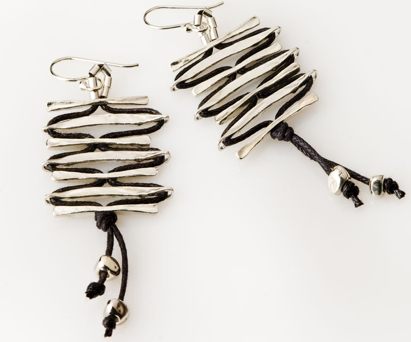
Hannukah is coming up around the river bend, and its almost time for gift shopping (I always find this a great excuse for any impluse buys up to three months prior to the holiday season). So go ahead and milk it!
22.9.10
Sukkah Art. also: from the dinosaur to the turkey, an evolutionary tale

 Ok bear with me here. Yes, I did find these decorating ideas on a blog meant for mothers. Yes, these are arts and crafts ideas meant for young children, or perhaps anyone with poor motor skills. BUT- you can't tell me you don't love a good finger painting project. I mean really, don't even try to dispute that this was the best part of kindergarten through grade 4. Actually, come to think of it, why did we ever get rid of finger painting? Escandalo.
Anyway, another reason why these are excellent is because they are kind of like Thanksgiving decorations. Which, even though I grew up in Canada, where Thanksgiving is at the "wrong" time of the year (October), and actually commemorates the giving of thanks as opposed to manslaughter through smallpox, I am still into those hand print turkey decorations. They are so clever! and entertaining! Who would have known that your palm=turkey? Also, did you know that turkeys are direct descendants of dinosaurs? It's true, I saw it on the National Geographic channel. And TV never lies. Remember that children.
finger painting 4 lyfe

Look Ma! No hands
 Aaaaaaaaaanyways, these projects look like fun, and they are pretty, plus require almost no motor skills to put them together. So there you have it- easy mitzvah points for us all. Happy holidays!
post script: special thanks to the blog 'Kosher on a Budget' for these holiday tips
16.9.10
ars in tractus

spotted: wall mural in Jerusalem
it could have been twee but I think its location (it is in an observant neighborhood better known for babies and religious schools than artistic touches) saves it, and instead it is charming and unexpected street art
also, I love street art that has an element of audience interaction... in this particular neighborhood (well all over Jerusalem really) people come to observe the old style architecture and particular religious lifestyle, so there is a lot of standing around and picture taking
this sassy lass catches you in the act and gives it right back to you.
sass+art= double win
it could have been twee but I think its location (it is in an observant neighborhood better known for babies and religious schools than artistic touches) saves it, and instead it is charming and unexpected street art
also, I love street art that has an element of audience interaction... in this particular neighborhood (well all over Jerusalem really) people come to observe the old style architecture and particular religious lifestyle, so there is a lot of standing around and picture taking
this sassy lass catches you in the act and gives it right back to you.
sass+art= double win
13.9.10
audio art: eviatar banai
The Banai artists are a veritable clan of artistic force, a pack of crazy talented musicians with distinct voices and styles. I love them all, but I recently saw Eviatar in concert and he stole my heart. Really he just stole it all in one fell swoop- got up there on that unassuming kibbutz stage and KILLED it, stole my breath away and stole the show.
I was literally mesmerized by him. His voice seemed to capture all the space around him, and for a solid hour there was only EVIATAR, crooning his heartbreaking, slightly sinister lyrics. I haven't seen an artist who seemed to grab the very air around them like that since I saw Regina Spektor silence a room of rowdy Russian fans with an acapella version of 'Poor Little Rich Boy'. With his inspirational tale of spiritual redemption (former, maybe current pothead who found God and is now religious) and complex lyrical compositions, he cuts a fascinating figure in the Israeli music scene.
I was literally mesmerized by him. His voice seemed to capture all the space around him, and for a solid hour there was only EVIATAR, crooning his heartbreaking, slightly sinister lyrics. I haven't seen an artist who seemed to grab the very air around them like that since I saw Regina Spektor silence a room of rowdy Russian fans with an acapella version of 'Poor Little Rich Boy'. With his inspirational tale of spiritual redemption (former, maybe current pothead who found God and is now religious) and complex lyrical compositions, he cuts a fascinating figure in the Israeli music scene.
Subscribe to:
Posts (Atom)